DESCRIPTION
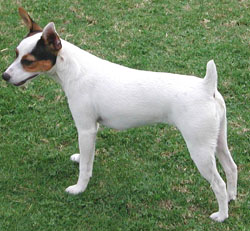
The measurement of wither to ground and wither to rear point of buttock should be of equal proportions. The length of the head and neck should always be in balance to the whole of the dog. The tail is preferably docked. The head is medium sized in proportion to the body. The head is only slightly arched between the ears. Domed or apple heads are highly undesirable. When viewed from the front and side, the head is to be wedge shaped and well filled in under the eyes. The stop is moderate and when measured from that point to the occiput it equals the distance from the stop to the tip of the nose with parallel plain. The color of the nose is preferably black with the exception of a true liver, which will have a liver nose. There should be strength in the muzzle. The eyes are not large, protruding or round, but slightly oval in shape. As dark as possible with a keen expression and pigmented eye rims. Light eyes and wall eyes are to be discouraged. The ears are V shaped with slightly rounded tips, set high on the outer edge of the skull erect or semi - erect. If semi-erect, the top third of the ear tips forward. Not wide or large at the base, rather medium in size. The length of the ear to be roughly equal to the width between the ears. The ears are of a thin texture (not thick). The mouth has strong jaws with full dentition and scissor bite. Lips to be tight fitting and pigmented. A wry mouth should be heavily penalized. The neck is strong and clean of good length allowing head to be carried proudly. The shoulders are well sloped back and not too heavily muscled. Forelegs are of strong round bone in keeping with the size of the dog, straight when viewed from any angle with sufficient length of the upper arm, which is well angled to the scapula ensuring the elbows are set under the body with the sternum clearly in front of the shoulder blades. The body is short, compact with a level topline, strong without slackness, with powerful loins. Ribs moderately sprung, back ribs deep and reaching well back with only a slight tuck up. The chest is of moderate width and reaching in depth to the level of the elbow, but not below. The Tenterfield Terrier is not too heavily muscled. The rump is well rounded with only a slight slope to the croup. The thighs are long and powerful. The stifle is well bent and the hocks well let down. The pastern should be parallel when viewed from the rear, and vertical when viewed from the side. The feet are compact, round shaped, toes moderately arched. The tail is preferably docked (3rd joint), high set and erect when alert but not carried over the back Carried gaily showing bold temperament. Sometimes a natural bobtail occurs. The fore and hind legs carried straight forward and parallel. The elbows should move perpendicular to the body, working clear of the sides, stifles neither turning in nor out and the hocks not close, with good rear drive coming from the well flexing hindquarters. The single coat should be short and of smooth texture. Coat colors are predominantly white with black, liver and/or tan markings in its various tones. Brindle markings acceptable but not preferred. Full color coats are not acceptable. Skin should always be pigmented.
HISTORY
As is so often the case, the origins of the breed are somewhat obscure. It is generally believed that smaller puppies from the litters of Fox Terriers were crossed with the progeny of other small breeds. Certainly, by the late 1800s a dog type known as the Little or Miniature Fox Terrier (known colloquially as ‘Mini Foxies’) was well established in rural Australia. By the 1920s the dog was a fixture in urban households as well.
The name ‘Tenterfield’ is sometimes incorrectly stated to denote the terrier’s place of origin as Tenterfield, New South Wales. Rather, Tenterfield is one of many Australian towns and villages in which small dogs of this type were known to exist. The town of Tenterfield is significant in Australian history, and the best-known owner of its saddlery was a man named George Woolnough, who was immortalized by his grandson, entertainer Peter Allen, as the “Tenterfield Saddler”. Mr. Woolnough owned a number of small terrier-type dogs; however, photographs of these dogs are not readily available. The name Tenterfield Terrier was suggested in the 1990s by Don Burke, a television personality of the era, and was adopted during the renaming of one of the then-Miniature Fox Terrier clubs.
TEMPERAMENT
Mini Foxies are known for being fiercely loyal to their owners and their owners’ property, a characteristic written into the breed standard. They must have an inquisitve and bold nature. According to at least one breed club, they make excellent family pets. They get along well with other animals but, like most working terriers, cannot distinguish between small pets - such as reptiles and fancy rats - and vermin, and must not be left alone with such animals.
Breeds
Get Handmade Dog muzzle
Dog Leashes For Large Breeds
|